Water Quality Map - Wai Map
Redesigned interactive water quality maps, enhancing usability and clarity for public and internal teams.
Role
Junior Digital & Graphic Designer
Industry
Public Sector Company Tool
Duration
12 weeks (research, redesign, and delivery)

Wai Map Link
Background
The Interactive Water Quality Map is used by Christchurch residents on SmartView website, and internal teams (including Three Waters and Smart Christchurch) to access and interpret environmental data across different locations. However, the existing maps presented challenges in readability, navigation, and clarity of geographic information, making it difficult for users to quickly understand key insights.
This project aimed to improve the usability and accessibility of both public-facing and internal map interfaces. As part of Christchurch City Council’s digital ecosystem, the redesign needed to align with established brand standards while supporting the needs of both general users and technical stakeholders.
Process
Research & Planning
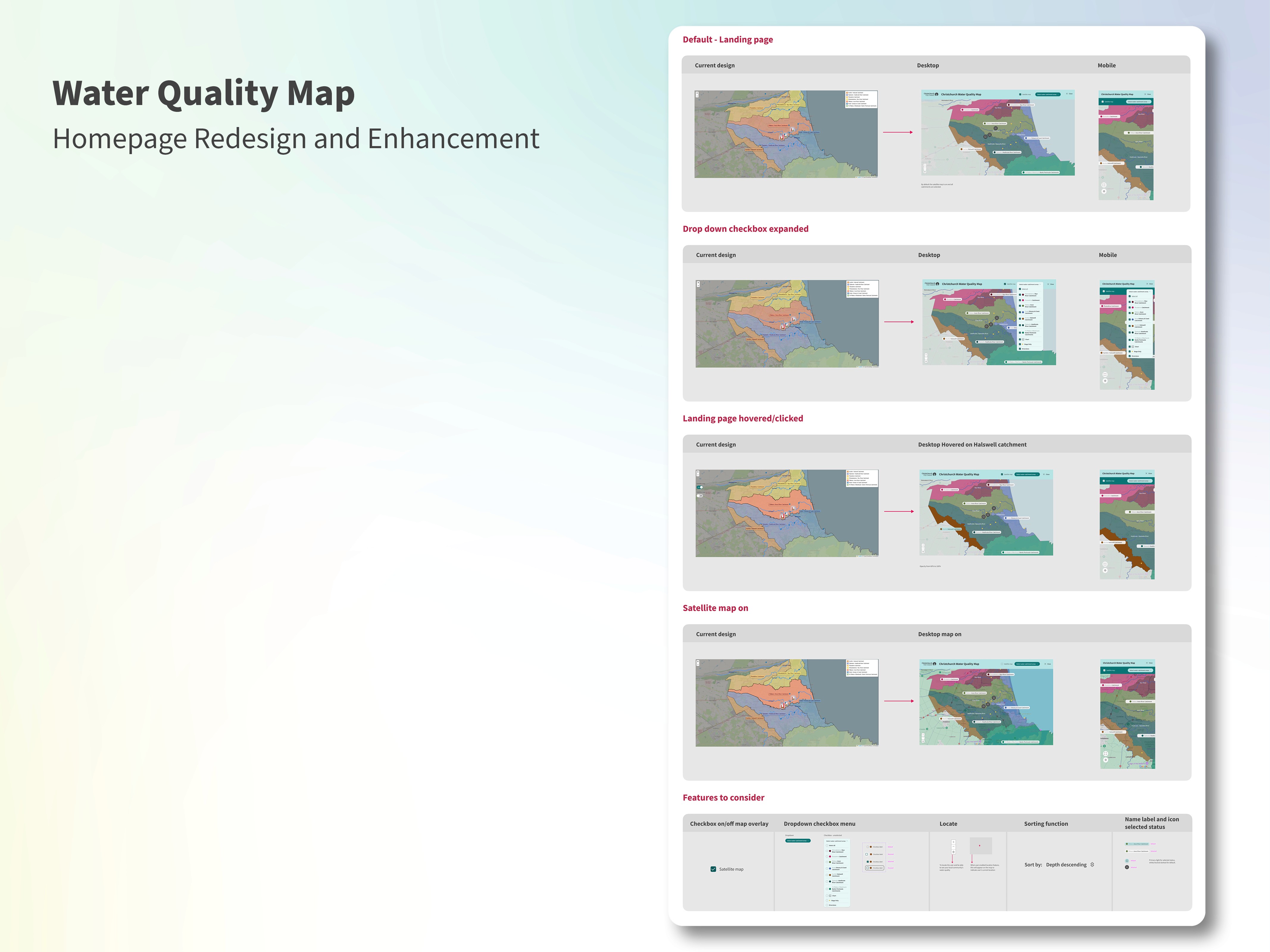
I began by reviewing the existing mapping interfaces to identify usability issues, particularly around unclear area labelling, inconsistent navigation patterns, and difficulty interpreting spatial data.
I worked with internal stakeholders from the Three Waters, Digital Channels and Smart Christchurch team to understand their workflows, data requirements, and pain points when using the maps. This helped define key user needs across both public and internal contexts.

Design & Prototyping
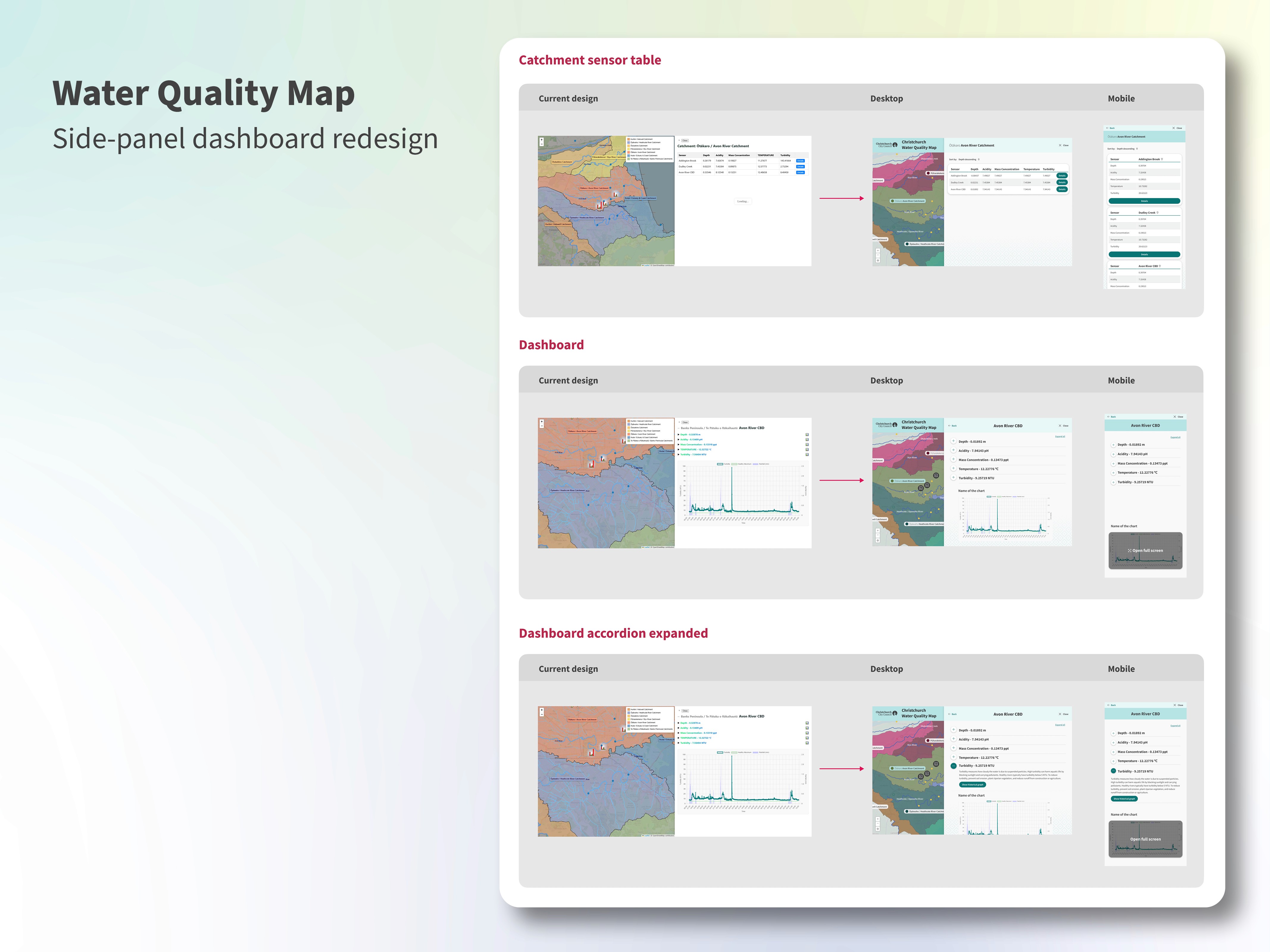
Based on the insights gathered, I redesigned the map interface to improve clarity and usability. This included refining area labelling, enhancing visual hierarchy, and simplifying navigation patterns to make interactions more intuitive.
I created high-fidelity UI designs that aligned with Christchurch City Council’s digital brand guidelines, ensuring consistency across platforms. Design decisions focused on making complex environmental data easier to interpret for a wide range of users.
Development & Implementation
I collaborated closely with internal teams and developers to ensure that the redesigned map interfaces were feasible and aligned with technical constraints.
Design specifications included clear interaction patterns, labelling systems, and scalable components that could be applied across both public-facing and internal tools.
Testing & Optimization
The redesigned interfaces were refined through stakeholder feedback and iterative reviews. Adjustments were made to improve usability, readability, and interaction flow.
Particular attention was given to ensuring that both technical users and general public users could navigate the maps effectively without confusion.
Solutions
Improved area labelling and visual hierarchy for clearer spatial understanding
Simplified navigation and interaction patterns across public and internal map tools
The redesign introduced clearer and more consistent area labelling, allowing users to quickly identify locations and understand water quality data without confusion. Visual hierarchy was enhanced through better use of typography, contrast, and layering, making complex spatial information easier to scan and interpret.
Navigation and interaction patterns were also streamlined to reduce friction. By simplifying how users move across the map and access information, the experience became more intuitive for both public users and internal teams. The result was a more cohesive system that supports efficient decision-making and everyday use.
Results
Improved usability and accessibility for both public users and internal stakeholders
Successfully aligned mapping tools with Christchurch City Council digital standards
The redesigned maps provided a more user-friendly experience, making it easier for residents to access and understand water quality information. Internally, teams benefited from clearer interfaces that supported more efficient workflows and data interpretation.
By aligning the design with council-wide digital standards, the project also contributed to a more consistent and cohesive user experience across platforms. This work demonstrates my ability to design for both public and internal users, balancing clarity, usability, and technical complexity within a single solution.
Other projects

Workflow Automation (WIP)
Improving an internal design briefing workflow by transforming complex stakeholder requirements into a clear, user-centred experience.

Campgrounds Website Redesign (WIP)
Creating a unified yet distinctive visual identity for four Christchurch City Council campground websites.

He Puna Taimoana
Led the redesign of the He Puna Taimoana website, improving usability, accessibility, and mobile-first experience.

Motion UI Accessibility
Led Motion UI accessibility research, defining principles, introduce Motion UI System and improving micro-interactions across council digital platforms.

What’s on UI
Redesigned the What’s On app onboarding and introduced a seasonal UI across mobile and desktop.